Hair extensions often appear to be a quick fix for getting longer, more abundant hair, but that unbelievably beautiful outcome you’re dreaming of? It isn’t necessarily going to happen. You’re expecting a fabulous transformation, but something’s just off. Perhaps the shade isn’t quite right, they’re surprisingly weighty, or they don’t fall as beautifully as you imagined.

Last updated by Hairporium · 24 May 2026
In this guide
Why Most Hair Extensions Don’t Look NaturalThe Real Decision FrameworkApplication MethodsLength and VolumeCommon Overextension MistakesMaintenance RealityMaintenance CommitmentLifestyle FitCommon MistakesStep-by-Step SystemThe Right Fit Over AppearanceFrequently Asked QuestionsIt’s generally not the extensions themselves that are at fault, but the selection of them. Extensions don’t just exist on their own; they interact with your natural hair, the styles you prefer, and the amount of effort you’re prepared to spend on their care. And when those elements aren’t in harmony, even stunning extensions can feel totally unsuitable.
Rather than just asking ‘what will look best’, it’s far more sensible to consider how they will be with your hair and with you, with your life. Not just the aesthetic.
A lot goes into that decision, in fact: the method of application is crucial for comfort and how securely they stay in, the length and fullness will influence how noticeable they are (or aren’t!), colour and texture are what make them blend seamlessly, how much maintenance is involved will show you how much work is required to keep them lovely, and ultimately, your lifestyle will determine if you can actually manage them over time. Looking at all this as a whole makes the decision much easier, and quickly cuts down an overwhelming number of possibilities to something much more sensible.
This isn’t about following the latest fads or mimicking a famous face. It’s about discovering what works for you and getting extensions that feel great from the beginning, and that means avoiding a lot of frustrating trial and error.
Usually, when extensions don’t look natural (even expensive ones!), it’s a mismatch, not a problem with the quality. A beautifully made set can still look wrong if they’re not compatible with your hair or how you usually manage it - problems often happen when you pick something that looks good in isolation but doesn’t work in practice.
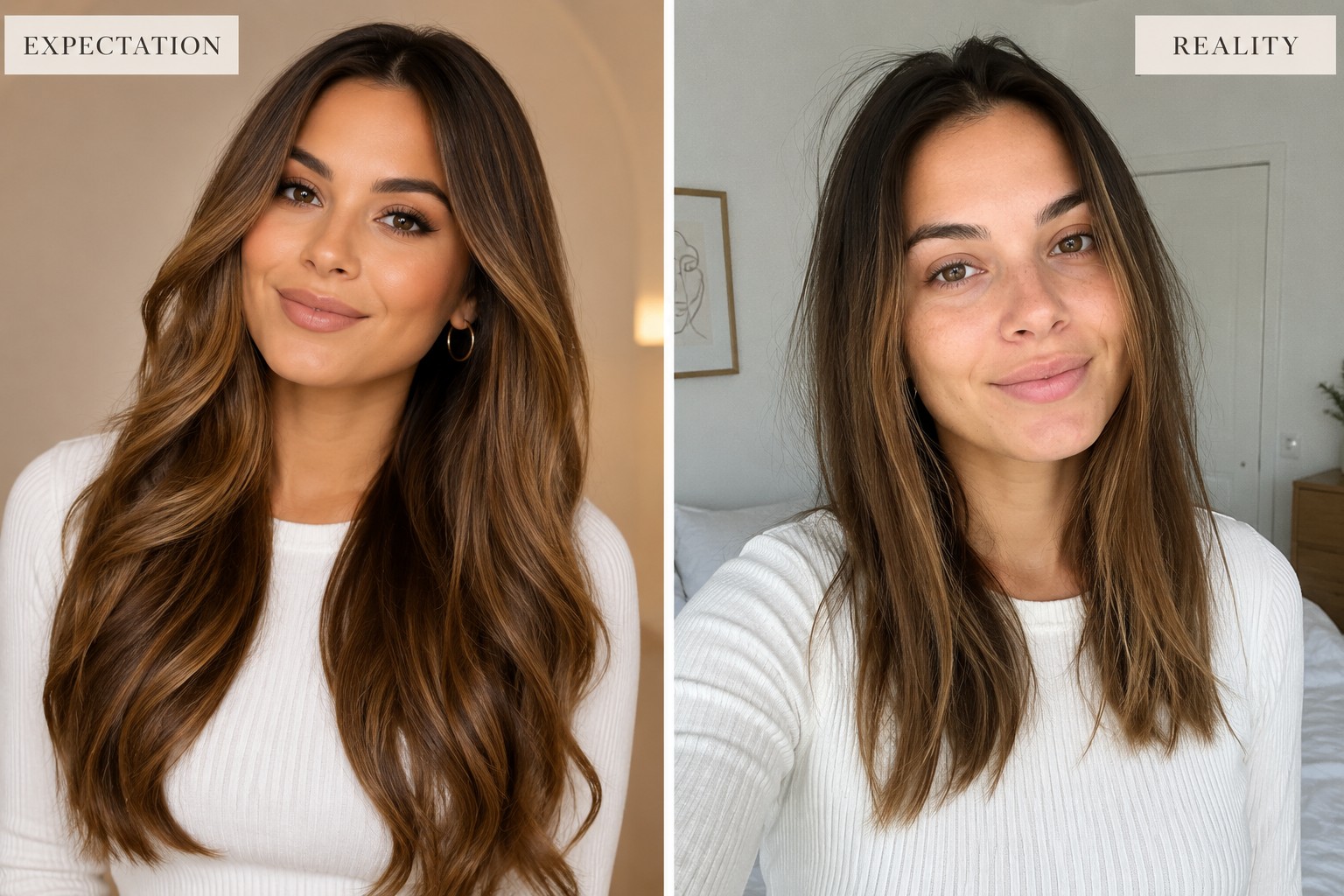
That “Looks Great in the Photo” trick is a really common mistake. Those pictures online are almost always professionally styled, lit, and digitally improved to show the most flattering image. The model’s hair has been expertly blended and often specifically chosen to go with those specific extensions.
In your day-to-day, your hair won’t behave in the same way. Your natural color, thickness, and wave are likely to be different, and that will affect how the extensions lie and blend. A smooth, voluminous look in a picture can end up looking obviously patched or unnatural without the same level of professional styling.
It’s tempting to think you’ll get the same result as the picture, but that’s rarely true without some work. That gap between what you’re hoping for and what you get often starts right there.
How your hair naturally behaves is a big factor in how extensions will appear and feel. If the textures don’t align – for instance, totally straight extensions with naturally wavy hair – a smooth finish will be hard to achieve.
Thickness is also important. Very thick extensions on fine hair will be too noticeable. And if you have thick hair, and the extensions are too fine, they won’t add the fullness you’re after.
And hair responds to the weather, humidity, and how you style it. Extensions should work with that, not against it. If they don’t move and fall as your natural hair does, they’ll look fake.
Not thinking about how you’ll actually use the extensions is another frequent problem. Wearing them for a party is very different from wearing them every single day.
Some need a lot of styling to keep up appearances, others are simpler. If your schedule doesn’t allow for that level of effort, they quickly become frustrating rather than useful.
You’re surrounded by choices and find yourself going back and forth, never quite certain what’s going to be right for you. But the goal isn’t to examine absolutely everything; it’s to narrow things down and to do that in a sensible order.
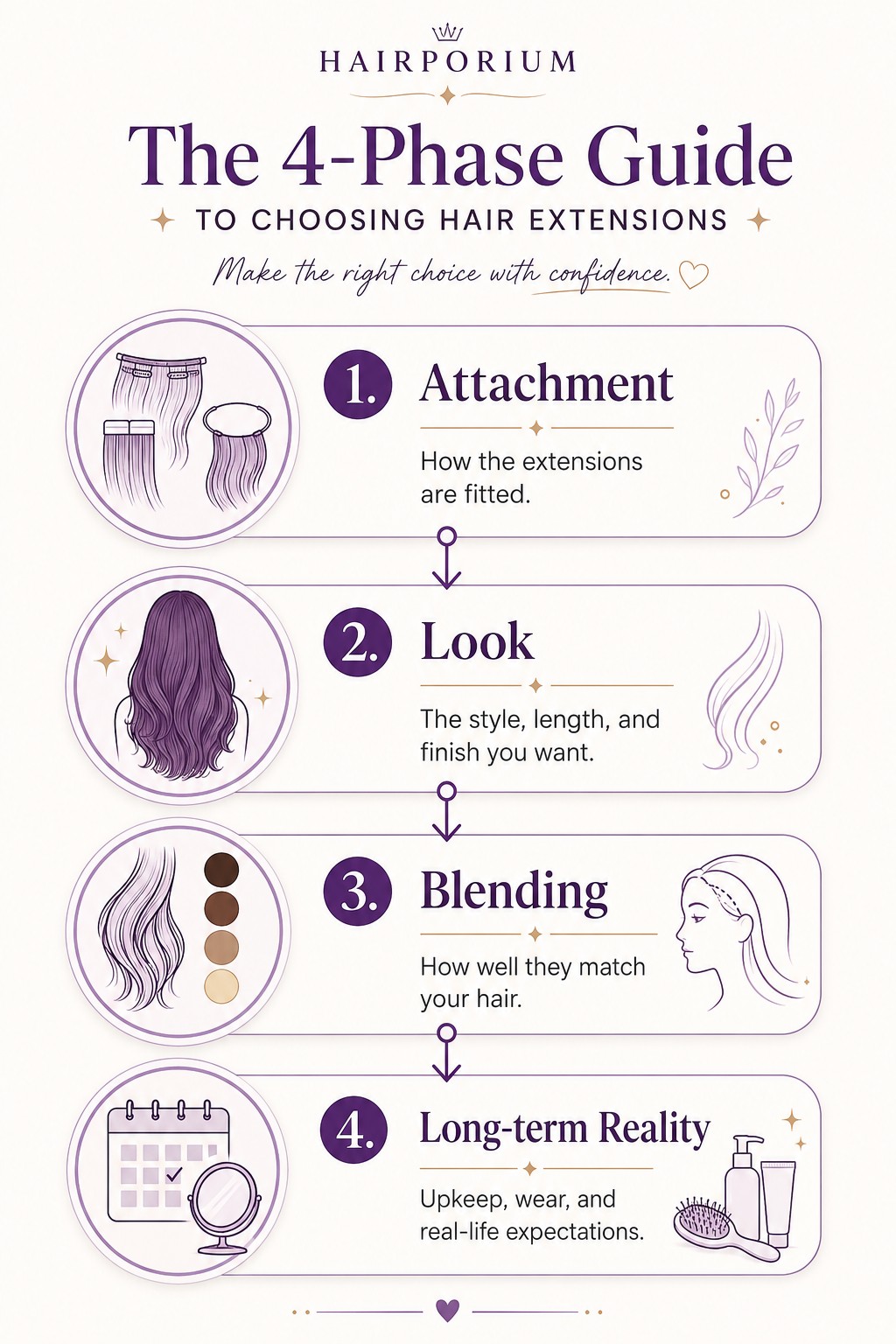
It’s much smarter to think about hair extensions in phases, looking at the big picture instead of each tiny detail. As you go through each phase, you’ll rule out what won’t work for you, slowly narrowing down your options to what you actually need.
How will they attach? That’s what determines how easily you can put them in and take them out. Some are a quick fix, flexible and temporary, others are longer-lasting and more robust, and naturally, this impacts comfort, how much say you have in the style, and how committed you’ll be to wearing them. Then there’s the look of them - length, thickness, overall shape are you going for something understated, or something that really turns heads?
And how well will they blend with your hair? Color and texture are vital. Even the most beautiful extensions will look obviously fake if the colors aren’t right, and a seamless blend is what creates a totally natural look. Also, and importantly, what will they be like to wear? Their weight, how comfortable they are, and how much work they need.
Something might be stunning when you first get it, but become a real pain in everyday life. Don’t only picture how they’ll look on the first day, actually think about what it’ll be like to have them in. Ultimately, how easily the extensions fit into your life as it is - your usual routine, your activity level, how you like to do your hair - is what will make you continue wearing them.
When you start thinking about extensions with all this in mind, the process suddenly feels much more peaceful. You aren’t overwhelmed by all the possibilities; instead, you’re looking at each one thoughtfully, and this careful consideration will lead you to far more sensible choices as you learn more.
Let’s look at how the different types of extensions are applied - how they’re put in, how comfy they are, how much they could damage your hair, and how realistically they will work with your lifestyle.
It’s not simply how they’re applied, it’s how they feel all day, how they behave as you go about your life, and what’s needed to keep them looking good for the long term. The best extensions should work with your usual routine, not disrupt it.
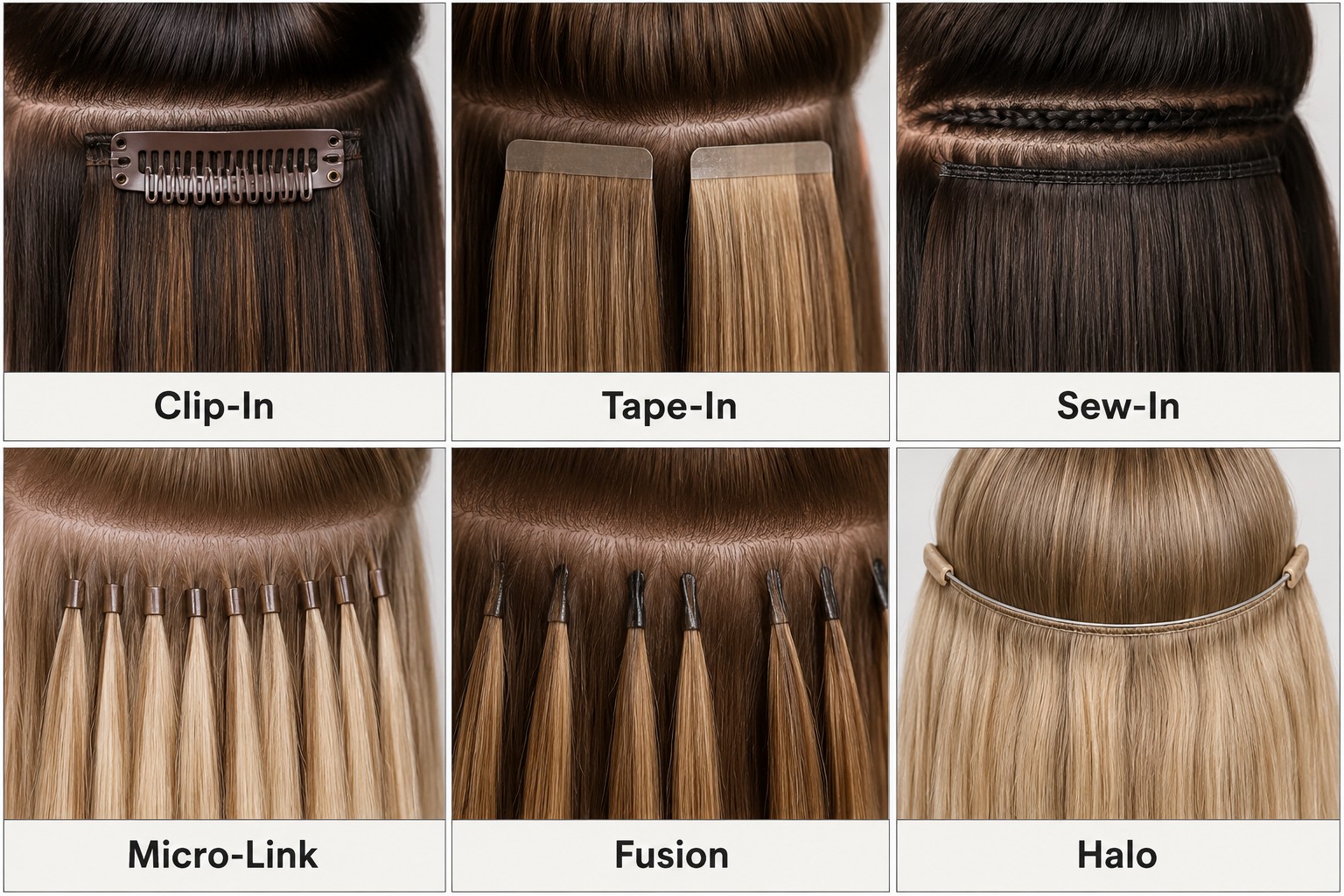
Clip-ins are wonderfully versatile, probably the most adaptable available. You choose when to have longer hair or more volume, and removing them is equally simple - they are for shorter-term wear. They’re a good place to start if you don’t want anything permanent, or if you enjoy changing your look.
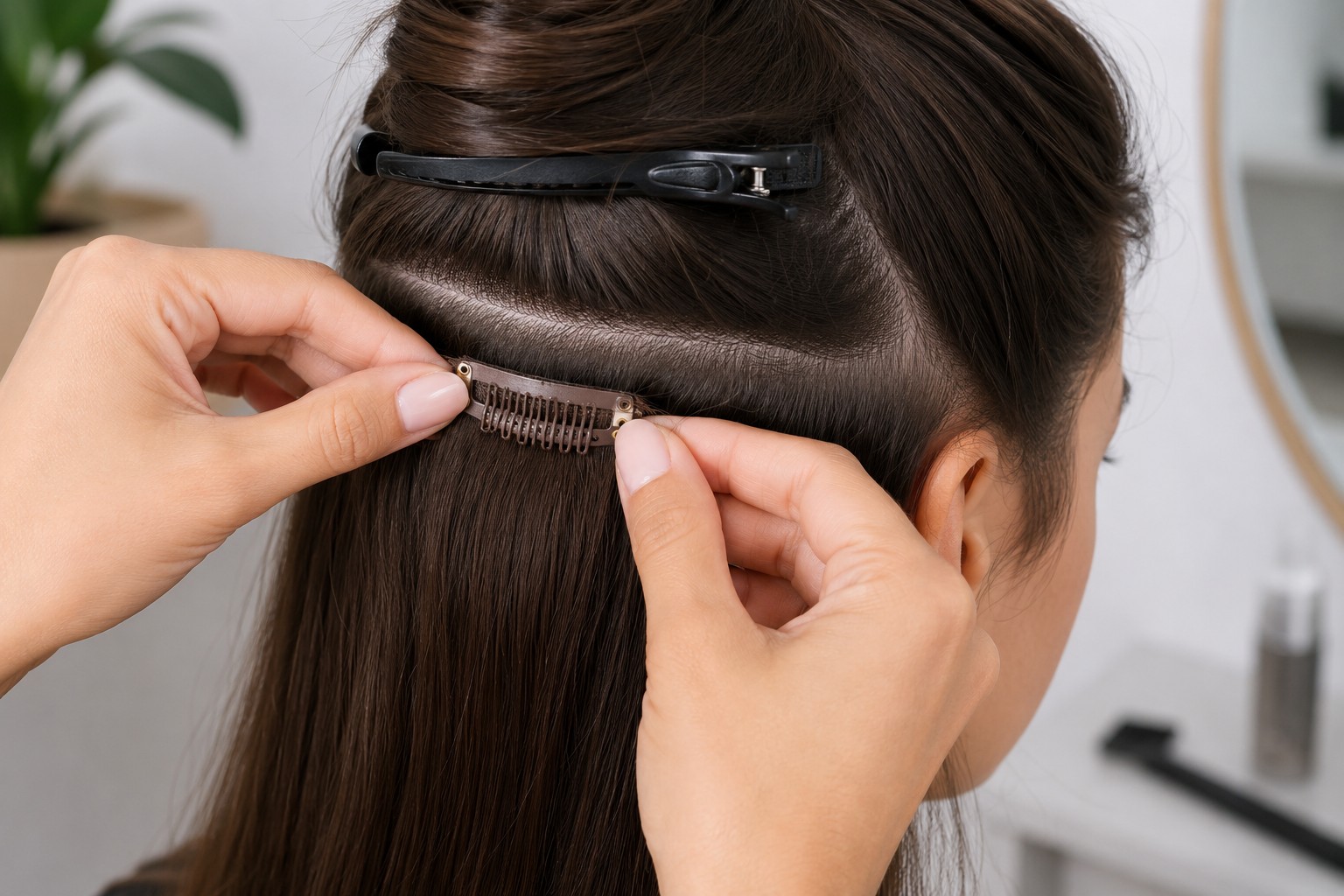
They attach to your hair with little clips and are surprisingly comfortable for a while. Being able to take them out means they aren’t constantly pulling at your hair, making them a kinder option if you are worried about damage.
You have complete control with clip-ins - you can reposition them, remove them at night, and avoid the build-up and maintenance of longer-lasting types. They do need a little time and effort to put in and blend in each day, but for many, that freedom is the whole point.
Tape-ins are a semi-permanent method and lie flatter, looking more realistic. Your hair is ‘sandwiched’ between the extensions using adhesive strips near the roots. This gives a smooth, lightweight sensation which is often more natural than heavier types.
They’re brilliant for adding volume without your hair feeling weighed down. Applied properly, they are flat, move with you, and aren’t as obvious as many other options.
They do need looking after, though. As your hair grows, the tapes need to be moved up (usually every few weeks). And they need to be treated gently - hair oils, heat and incorrect washing can all weaken the adhesive over time. If you want something that lasts longer than clip-ins, but is still fairly light, tape-ins are a good shout…but you must be prepared for the upkeep.
Sew-ins (weaves) last a good while and are very secure. Your natural hair is braided into a base, and the extensions are sewn onto the braids, providing a really strong hold.
Because of the way they’re put in, sew-ins are generally better for thicker or coarser hair that can withstand braiding. They offer lots of volume and length and stay firmly in place, even when you’re exercising.
They can feel heavier and less flexible, especially if your hair is braided tightly. You also have to be careful they don’t pull on your scalp, which can be uncomfortable if the braiding is too tight. For lasting, secure results, micro-link or beaded extensions are a good option, though they do need to be a good match for your hair’s texture and how much pull you’re comfortable with.
These are applied by attaching small pieces of extension hair to your own with tiny beads or rings – they’re clamped to secure the extension, and there’s no glue or heat involved. This gives a more natural flow and a softer feel, blending nicely with your hair, and being lighter and less restrictive. They can be adjusted as your hair grows, the links moved up to avoid a full re-do, and because of this, they’re reusable.
Fusion/keratin bond extensions use keratin bonds to directly attach extension strands to your hair. Heat is used to make each strand stick, creating a strong, long-lasting hold lasting for months. Because they’re put in one strand at a time, they look incredibly natural and allow you to position them exactly where you want them, which is fantastic for a seamless blend, especially in longer hair.
However, they are among the most skilled and lengthy applications - the fitting takes hours - and careful removal is essential to prevent damage. You’ll also need to maintain them to stop them from becoming tangled or overstraining the bonds. Fusion extensions are for those wanting a long-term solution and are prepared to put in the time to have them applied and looked after.
Halo extensions are amongst the simplest and are brilliant for first-timers. They sit on your head with a very fine, practically invisible wire, and your own hair covers the band to hide it. There’s nothing attaching to your hair itself, so no pulling, no glue, and absolutely no risk of damage from the application. You just place it on, adjust it, and use your hair to cover the band.
Because of this, they are very quick to put on and comfortable for shorter wear, and are particularly good if you want some extra volume or length occasionally, without something more permanent. Their main drawback is needing careful positioning and blending for a natural look, and they aren’t as secure during very active pursuits. They are a really accessible starting point for their ease, comfort, and straightforward nature.
Nearly everyone gets this wrong. It’s tempting to think “longer and thicker is best” when you’re aiming for a significant change, but extensions don’t exist in isolation from your own hair, and a dramatic change will likely look obviously artificial.
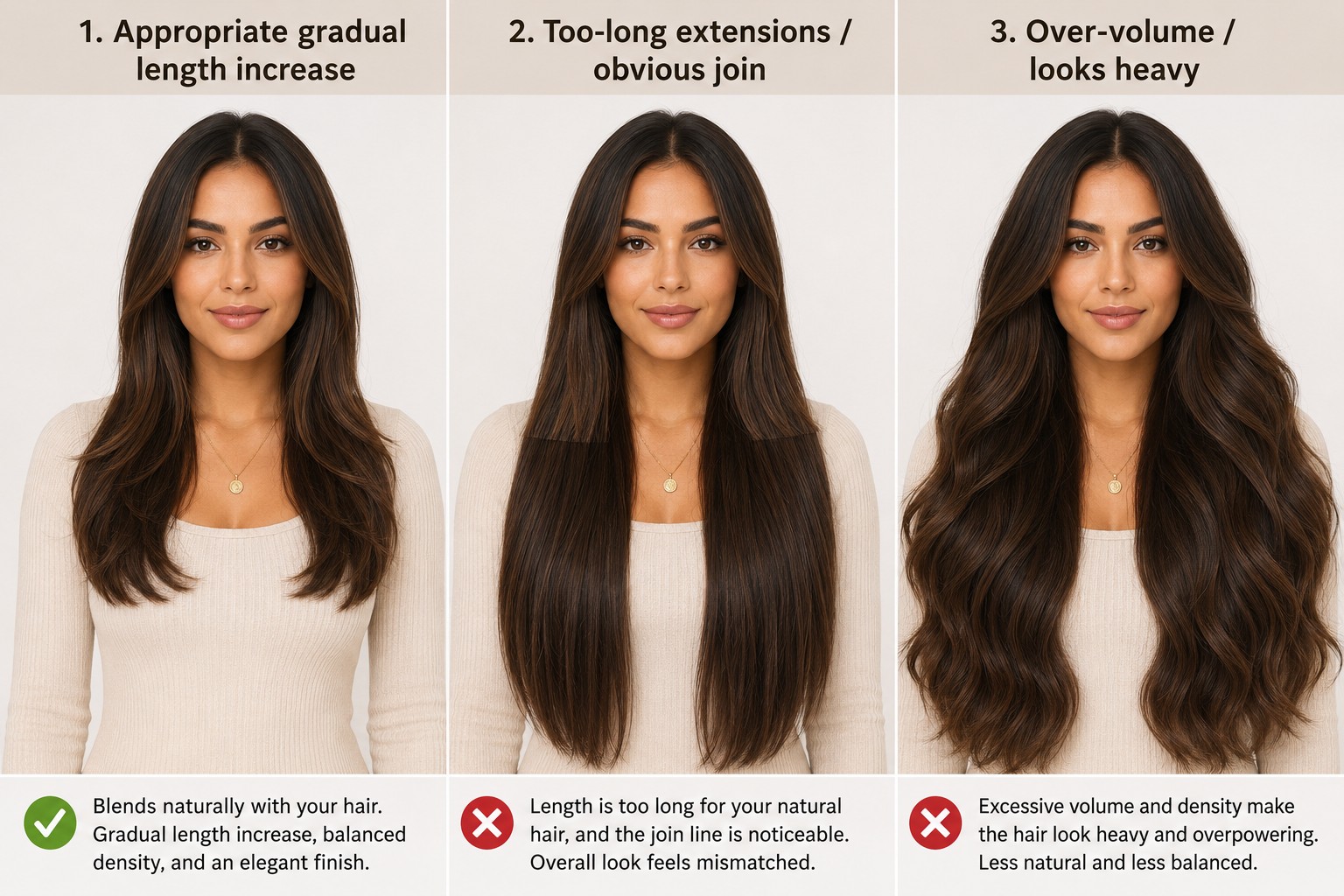
When it comes to length, it should continue naturally from your own. As a general rule, don’t jump too far ahead of your current length all at once. For example, if your hair is shoulder-length, going straight to waist-length will create a very obvious join.
The ends of your own hair need to merge with the extensions. A big difference in length makes it very difficult to disguise the point where your hair ends and the extensions begin, often creating a clearly layered or uneven appearance, which doesn’t create the illusion.
A more gradual increase in length is almost always more successful, allowing the extensions to blend more smoothly and maintain a consistent overall shape. The closer the extension length is to your natural length, the easier it is to make everything look as if it’s one.
Volume and density are often used interchangeably, but they actually change your appearance in different ways: volume is how much hair you see overall, how full it looks, while density is the quantity of hair actually added. Increasing volume can really improve your natural shape and give the impression of healthier, more balanced hair.
However, adding lots of density creates bulk, and with naturally fine hair, that’s when extensions start to look heavy and clearly aren’t yours. The goal isn’t maximum fullness, but getting things in proportion. You want enough volume to support the length, but without the hair looking unrealistically thick. When the volume is in line with the weight and movement of your own hair, it appears more genuine.
Length and thickness need to work as a pair. As a general rule, longer extensions usually need more volume to prevent them from looking a bit sparse at the ends, but that volume needs to be kept under control.
Extensions that are long but don’t have enough fullness look stringy. And extensions that are both long and really thick can feel heavy and be tricky to blend. It’s about adjusting both together instead of concentrating on just one.
The Hairporium AI Stylist considers your hair type, lifestyle and budget to recommend the right extension method for you. Free, no account needed.
Get my extensions recommendation →
Rushing to a dramatically longer length too fast is a really common problem, and it’s glaringly obvious, difficult to make look natural, and usually ends up looking totally fake. And piling on too much thickness? Tempting as it is to think more hair is better, it can actually make the extensions more noticeable and even uncomfortable to wear. Truly natural extensions happen when you’re careful and choose length and fullness that work together; a balanced approach gives a result that feels easy, natural, not over the top.
Then there’s color matching, and honestly, this is what makes or breaks the whole thing. Even extensions that are absolutely perfectly applied will look off if the color isn’t blended in properly. You can have the right type, the right length, the right amount of hair, but if the color isn’t right, they’ll always appear as something added on. Color is what makes extensions look as if they are genuinely sprouting from your scalp.
Don’t attempt to match extensions to your roots! Almost always, your roots are a little darker or at least a bit different than the rest of your hair - especially if you dye it, have highlights, or have natural variation in color. Much better to match the mid-lengths and ends of your hair. That’s where the extensions will be sitting, where they will be blending in, and where the color needs to be closest.
A smooth blend at the ends makes it much harder to tell where your hair ends and the extensions begin. Looking at your hair in daylight is a clever move. Indoor lighting can fool you, but natural light shows you your true color.
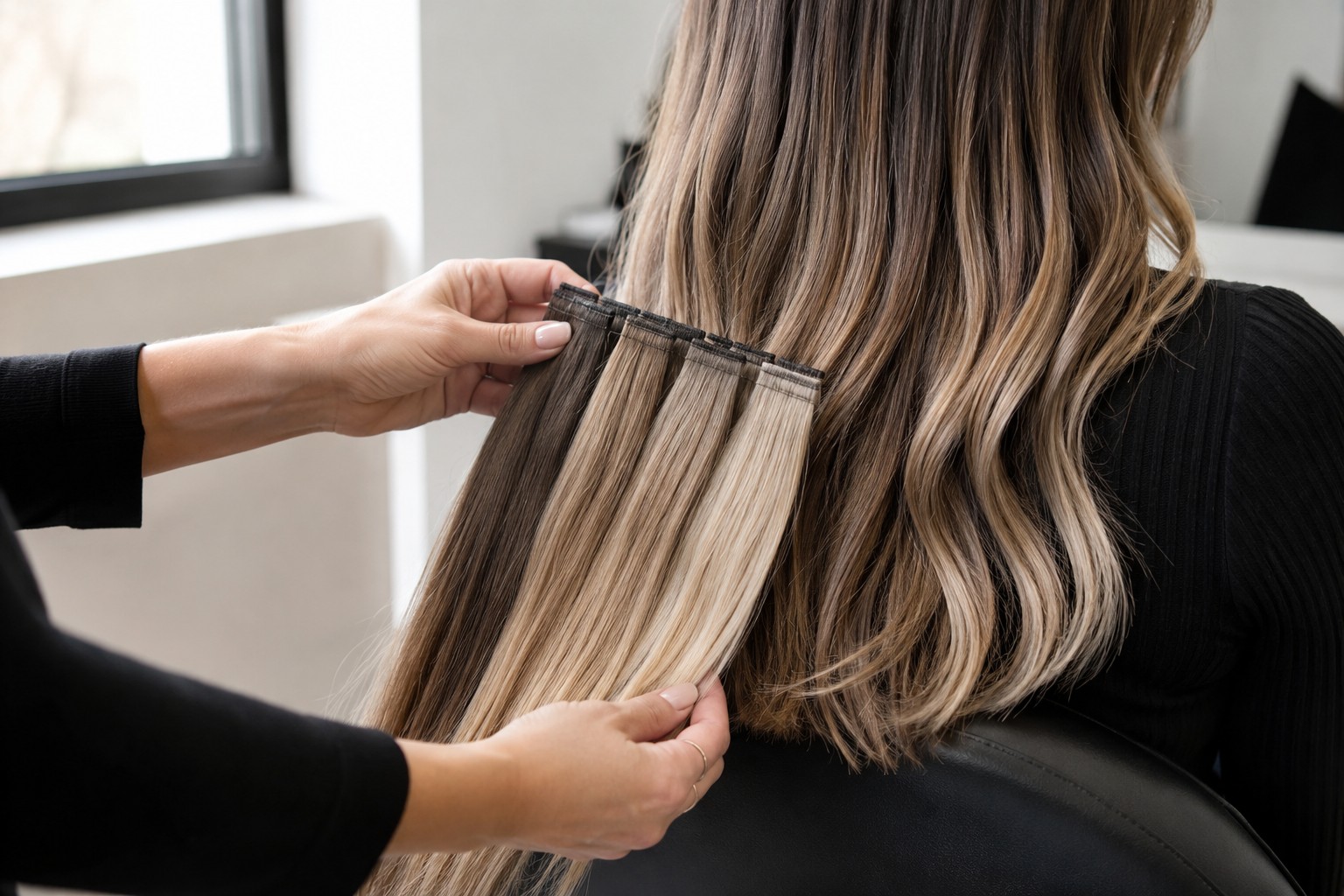
For something that looks real, hair is almost never one single color. Usually, it’s a collection of subtle lighter bits, darker strands, and a whole lot of little shifts in shade, which give it depth. Extensions that have a similar multi-toned effect will look a lot more believable. A single color extension can sometimes appear a bit flat, particularly against your own hair, which has all that variation.
Multiple shades within the extensions get rid of that flat, single-color look and help with a smoother blend. Choosing extensions with a little color difference, or even combining two very similar colors, can improve the final look massively. You’re aiming to mimic the natural complexity of your own hair, not try for a perfect, but ultimately artificial, match.
And occasionally, even if you’ve selected a color that’s really close, you’ll want to adjust it a little. Toners or a tiny bit of color adjustment are for situations like this. Hair extensions made of human hair can almost always be toned to be an even closer color match. However, a drastic color change to the extensions isn’t a great plan.
It’s far better to start with a near color and tweak it slightly, rather than attempt a complete re-color afterward. Staying in a similar color family keeps the hair healthier and the blend easier.
Now, the reality of keeping them up, and what you’ll actually be doing with them every day, is where a lot of people’s expectations fall apart. Extensions might look amazing as soon as they’re put in, but how they are to live with is what truly counts.
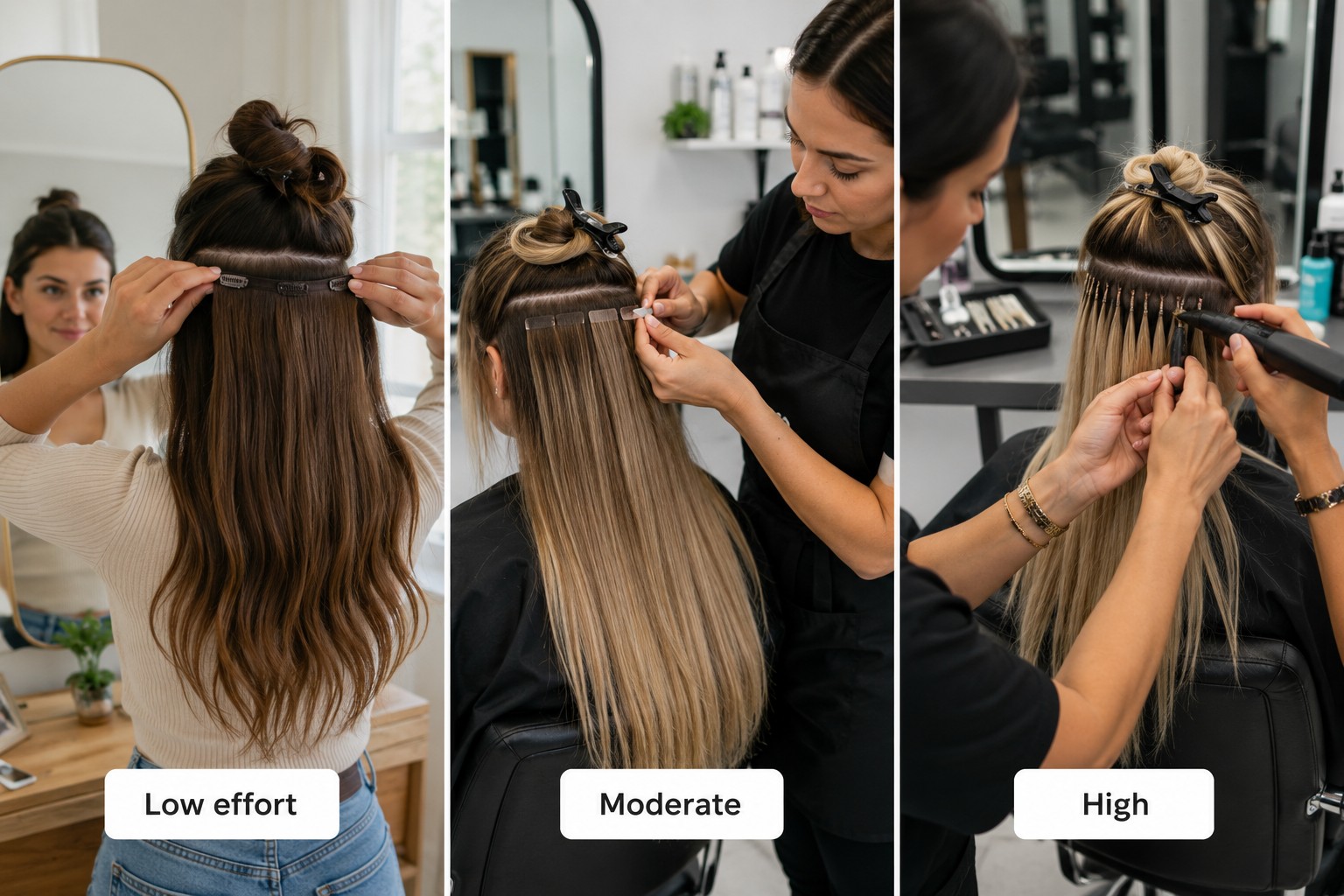
How much work they need to stay looking good is what will decide if they’re a good idea or a source of frustration.
Clip-in and halo extensions are the lowest maintenance. They’re designed to be flexible: you put them in when you want, and take them out when you don’t, and that reduces the amount of upkeep a lot.
They don’t need to be fussed over constantly, as you aren’t wearing them 24/7 - so you won’t get build-up, a constant tug on your scalp, or be forever readjusting. Mostly, looking after them is just what you do with your hair: brushing, a wash every now and then, and putting them away tidily.
If you like to be in charge and prefer things uncomplicated, they’re brilliant. You will, of course, need to put clip-ins in yourself each time, but a lot of people actually find that easier than constantly dealing with other kinds of extensions.
Tape-ins and micro-links occupy a space in the middle. They stay in for a longer stretch and appear more naturally, as if they’ve always been there; they do need fairly frequent maintenance.
With tape-ins, you’ll need them moved up as your hair grows, and you have to handle them carefully so the adhesive keeps holding. Micro-links require occasional adjusting to remain both secure and tidy.
They’re a good compromise - not overly simple, yet not a massive undertaking. You won’t be fitting them daily, but they will need some attention to both look and feel good.
Fusion and sew-in extensions are the biggest ask of your time. You’re meant to have them in for ages, and a hair expert is needed for both applying and removing them. They typically require a lot of looking after: careful washing and styling, plus regular check-ups to make sure they aren’t getting tangled or tugging on your natural hair. And because they’re in for so long, if you ignore a problem, it’s only going to get worse. They’ll give a really sleek, long-lasting result, but only if you’re prepared to put in the effort, or they’ll very quickly become a huge headache.
What people surprisingly often forget when getting extensions is how well they’ll actually mesh with your life, the one you actually live, not the one you wish you had. A lovely style that doesn’t suit your daily activities won’t hold up. The very best choice is one that simply fits into what you do every day.

Really consider how much time you usually spend on your hair. Some extensions need daily styling and a gentle touch, while others are much easier. If your mornings are a mad dash, a complicated routine simply won’t happen. However, if you enjoy playing with your hair and aren’t bothered by the time, you’ll have more options. Being honest about what you normally do will stop you from choosing something that will become a nuisance.
Your activity levels are, believe it or not, quite important. Lots of workouts, a lot of travel, long and hectic days? Then you’ll need extensions that stay put and don’t need constant adjusting. More delicate or looser styles might not hold up to all that movement, and whilst more secure ones will stay in, they could feel heavier. It’s about finding a comfortable, secure balance, depending on how much you go, go, go.
Then there’s the weather to think about! Heat, humidity, and perspiration all impact both your hair and the extensions, altering how they hold a style, their texture and how comfortable they are. In warmer climates, lighter, more breathable extensions are usually much nicer; heavy ones get uncomfortable and are harder to deal with. Choosing extensions that work with the climate, instead of against it, will make them far easier to wear.
To choose hair extensions without regretting it, start with something simple and gain some confidence. If you’re new to extensions, and you want to dodge regret, then go for something straightforward - seriously, you will regret it if you don’t! Picking the wrong type usually leads to frustration, more expense, and a complete restart. The point is to gradually get used to them.
Clip-ins and halo extensions are usually the easiest; they’re uncomplicated, aren’t a huge commitment, and allow you to play with different lengths and volume without making a permanent change to your hair. You can take them out and experiment, see how well they blend with your own hair, without being stuck with a style. They’re a very sensible place to begin.
And if you’re just starting out, don’t go for complicated methods like fusion or anything very weighty. Those require a professional to put in a lot of aftercare and a substantial time commitment. They could be completely overwhelming whilst you’re discovering how extensions work and what suits you.
Don’t overcomplicate things at the beginning, and you’ll feel more confident with less stress. The absolute best way to really get extensions is to use them. Start with the easier types and see what you’re comfortable with, what looks good to you, and how much work you’re willing to put into looking after them. Once you’re happy with those basics, moving on to more complicated methods (if you want to!) will be a lot easier.
In-depth guides for every hair extension decision — by type, method and lifestyle.
Lots of hair extension problems sadly all have the same root cause. It’s almost never the extensions themselves, but rather choices that don’t suit your hair, or the way you actually live. If you avoid these errors in the first place, things are much smoother.
Don’t suddenly go from a short bob or shoulder-length hair to incredibly long extensions in one jump. That much change is obvious, and they’ll be harder to make look as if they’re part of your hair. Increasing the length gradually is easier to wear and simply looks better. And don’t ignore your hair’s natural wave, curl, or straightness.
Extensions that don’t match are difficult to hide - straight extensions on wavy hair (and the other way around) will need constant styling to look consistent. Choosing a texture that suits your hair reduces styling and gives a better result.
Even a small difference in color can loudly announce ‘extensions!’ Getting the shade wrong or forgetting about your hair’s underlying tones will create a very obvious line. Seamless blending is what makes extensions look as if they are your hair, not something added to it.
And don’t add too much fullness. Too much volume makes them feel heavy, look fake, and usually draws attention to the extensions, rather than improving how you look. Natural volume is always the best. Oh, and choosing a method that needs a huge amount of time and care is just going to be irritating. The right method should be easy, not a burden.
To have a sensible, step-by-step system for choosing hair extensions, create a routine, something you do in the same way each time. Instead of just hoping for the best, have a specific order of steps to help narrow down your choices and avoid typical mistakes. First, think about when you’ll be wearing them - all the time, or only for parties and occasions? That tells you how much effort and commitment you’re prepared for. Then, pick a way of putting them in that suits how you feel and your lifestyle.
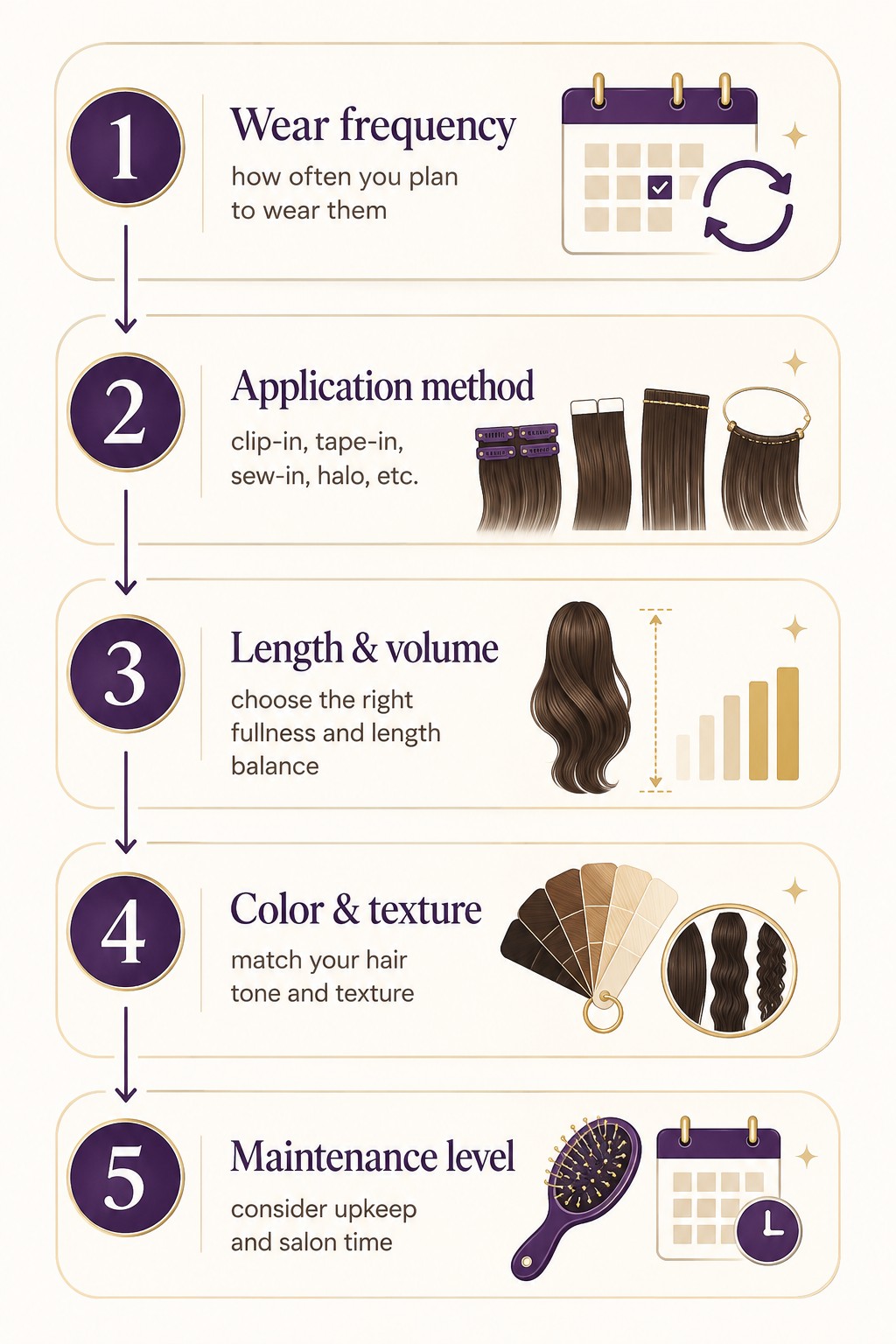
Temporary options give you flexibility, while longer-lasting ones are consistent. After that, decide on a length and volume that suits your hair. Don’t go for anything too dramatic that will be hard to blend. Then, make sure the color and texture are the same as your own hair - that’s how you get a natural look. Be realistic about how much maintenance you’re willing to do; pick something you can manage. And if you can, start with something easier before committing to something more permanent.
Finding extensions that truly work for you isn’t about choosing the prettiest ones. It’s about finding the right fit. Thinking about how they’re attached, how seamlessly they blend in, how they feel, and how they fit with your everyday life makes the decision much clearer.
Aim for balance, not extremes. When extensions enhance your hair and your lifestyle, they feel totally natural and easy. Then you can choose with confidence, instead of just hoping for the best.
Clip-ins are removable for short-term wear with no commitment. Tape-ins are semi-permanent flat extensions that look more natural but need moving up every few weeks. Fusion bonds use heat to attach individual strands and last months — the most natural-looking but require hours to apply and careful removal.
Clip-ins and halo extensions are the easiest to start with. Halos sit on a fine wire with no clipping, gluing, or pulling on your natural hair. Clip-ins let you experiment with length and volume without commitment. Avoid fusion or sew-ins until you’re more experienced.
Match to the mid-lengths and ends of your hair, not your roots. Check in natural daylight rather than indoor lighting. Choose extensions with subtle color variation rather than a single flat shade — multi-toned extensions blend more naturally with your hair’s variation.
Damage usually comes from poor application, removal, or maintenance — not the extensions themselves. Clip-ins and halos are the lowest-risk options. Tape-ins, micro-links, and fusion extensions can damage hair if applied too tight, removed incorrectly, or maintained poorly. Work with an experienced stylist for permanent methods.
Don’t jump too far ahead of your current length at once — going from shoulder-length to waist-length creates an obvious join. A more gradual increase blends much more smoothly. Length and volume need to balance: long, thin extensions look stringy, while long, very thick extensions look heavy and fake.
Continue exploring the other Hairporium guides covering hairstyle decisions, wigs, maintenance, lifestyle, hair problems, and our decision engine.
What Hairstyle Suits Me?How to Choose the Right WigHair Maintenance GuideLifestyle Hair GuideHair Problems GuideHair Decision EngineThe Hairporium AI Stylist analyses your hair type, lifestyle and budget to recommend the best extension method for you. Free, no account needed.
✓ Matches extension method to your hair type and lifestyle
✓ Personalised recommendation in under 2 minutes
✓ 100% free — no account, no sign-up required
Start your free hair consultation →