Most hair mistakes don't come from a lack of ideas. They come from not knowing what will actually work for you. Here's how a Hair Decision Engine and AI Hair Stylist change that.
Get Your Hair Plan FreeExplore Hair GuidesLast updated by Hairporium · October 19, 2026

In this guide
The Real ProblemWhat Is an AI Hair Stylist?Rethinking the Decision ProcessWhat Is a Hair Decision Engine?Different From Basic AIWhy Multiple Checks MatterWhy Hairporium Created ItHairporium's New CategoryHow the AI Stylist WorksHow Hairporium Differs From Typical AIStructured Decision PathReal-World ConstraintsWhy Hair Decisions Are ComplexToo Many OptionsFrom Trial-and-Error to StructuredApplying to StylingBefore vs AfterReducing GuessworkFuture of Hair DecisionsStop Guessing, Start DecidingFrequently Asked QuestionsWe rarely get hair decisions wrong for lack of ideas. We get them wrong because we don't know what will actually work. A style, color or set of extensions looks fabulous on someone else, yet on you it doesn't feel right: the cut is off, the color washes you out, or the product is a disappointment.
That's where most of us get stuck. It isn't a lack of inspiration; it's the lack of a sensible way to decide what will genuinely suit us. So we guess. We follow trends, listen to other people or try things and hope for the best, and too often we end up wasting money and time and feeling frustrated.
The focus needs to change. The challenge isn't finding hair ideas; it's making structured choices about your hair.
That's where a Hair Decision Engine, and the AI Hair Stylist within it, comes in. An AI Hair Stylist is a digital hair consultation tool that uses AI to help you make better decisions about hairstyles, wigs, extensions and hair care, based on your goals, lifestyle, preferences and maintenance needs. It considers your facial features (optionally), what you like and what's realistic for your hair, then suggests styles and care routines that suit your real life, not just a pretty picture.
A Hair Decision Engine is a structured guidance system that helps you make better decisions about hairstyles, wigs, extensions and hair care before you spend money, visit a stylist or commit to a new look. Rather than being another source of style ideas, it covers the whole decision. Hairporium has built exactly that: a system designed specifically for practical hair choices.
This isn't about the latest trends or what everyone else is doing. It's about how a structured approach takes the guesswork out of your choices. The aim is simple: to give you clarity before you cut, color, spend money or commit, so every choice feels deliberate rather than an experiment.

The real issue isn't a lack of options; it's the lack of a way to decide. There are endless styles, products and ways to change your hair, yet most of the time you're still unsure or end up making the wrong choice. Without a way to narrow down and assess what will work for you, you end up reacting instead of choosing deliberately.
There are simply too many choices and no way to sift through them. From cut and color to styling tools, treatments, extensions and wigs, the market keeps growing, with new options appearing all the time. What should feel empowering often ends up feeling confusing.
When everything is available, it's hard to know where to begin. You compare endless styles and products and try to work out what matters, but there's no clear way to prioritize. Should you think about your face shape, the effort involved, the health of your hair or what's in fashion? Most people aren't sure, so they go with whatever catches their eye in the moment.
The result is haphazard decisions. One choice follows a trend, another follows a friend's advice and another is simply the easiest option. Without a way to filter, there's no consistency or logic to the process, just a series of unrelated attempts.
Something that looks good doesn't necessarily suit you. Social media is full of carefully produced images and videos, with perfect lighting, professional styling and often heavy editing. They're inspiring, but they don't reflect your hair or your everyday life.
Your face shape, your hair's thickness and texture, and your lifestyle all have a big impact on how a style will work for you. A cut that looks amazing on someone else might fall limp on you. A color that brightens another person's complexion might clash with yours. These differences are easy to miss when you're deciding on looks alone.
So you end up with something that doesn't quite suit you. You chose it because it looked good, not because it was right for you, and you only realize that afterward.
Trial and error is expensive, and with hair the costs add up quickly. A bad cut can take months to grow out. The wrong product can cause damage or, at best, gather dust in a cupboard. Ill-fitting extensions or wigs feel awkward and don't look natural. And it isn't just the money: fixing a mistake means more salon visits, more product swaps and more attempts to find what works, all of which stall your progress.
It's emotionally draining, too. A disappointing result knocks your confidence and leads to frustration, then either extreme caution or a cycle of impulsive decisions.
The problem isn't a lack of ideas; it's the lack of a method for choosing between them. What's needed is a decision-making framework, not more options, and a way to stop those options turning into costly mistakes.
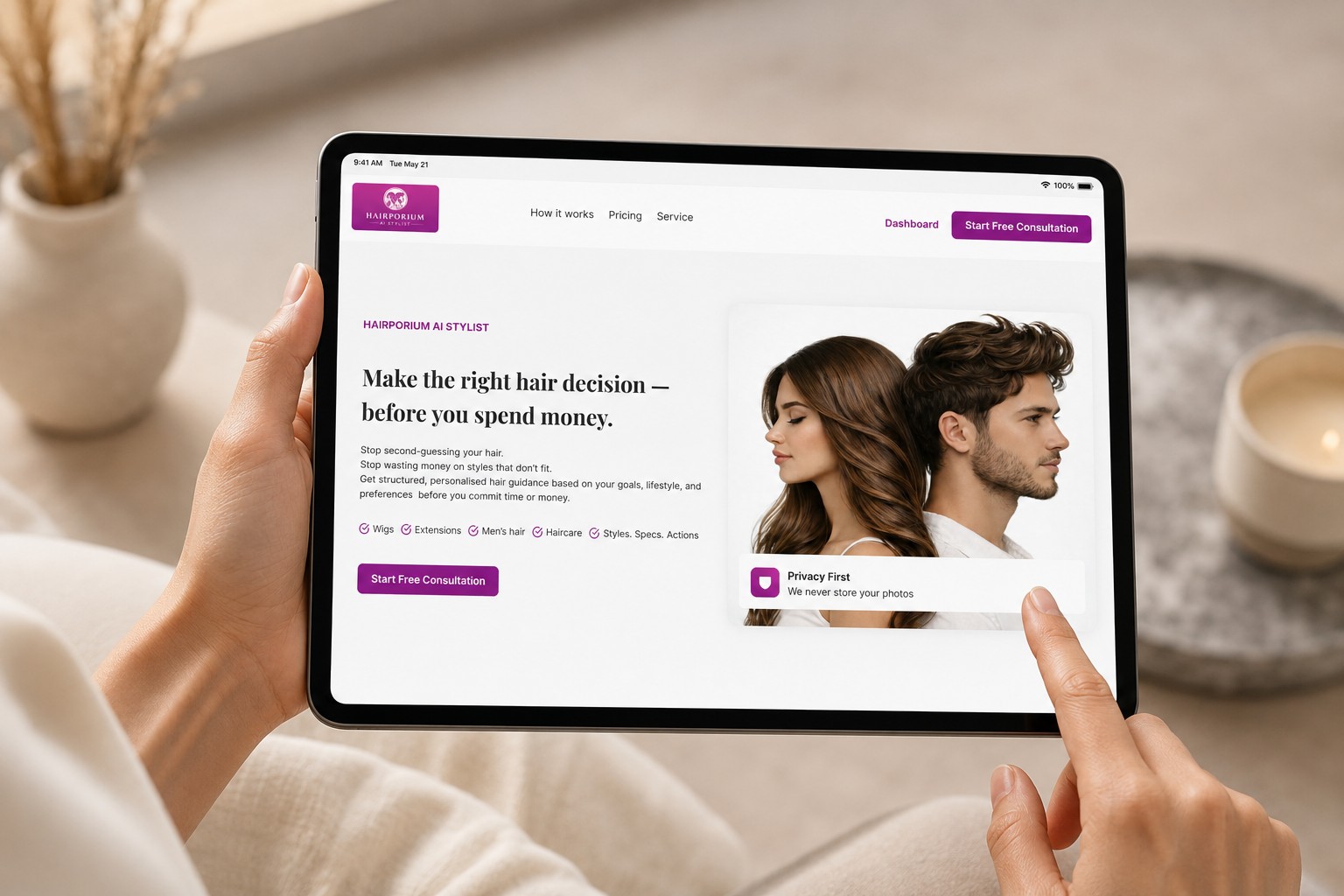
Most people picture an AI Hair Stylist as something that simply suggests hairstyles, showing you different looks or placing them on a photo of you. A good one goes much further. It's a system that helps you choose, not just a visual aid, and that's what the Hairporium AI Stylist is built to do.
The Hairporium AI Stylist is an AI-powered hair consultation platform that gives you structured guidance on style direction, product specifications and next steps, so you can make hair decisions with more confidence. It doesn't rely on what looks appealing; it works from the information that directly affects the outcome.
Typically, that includes your face shape and proportions (optional), your hair type, texture and thickness, your budget, your lifestyle (how much time you have for upkeep and what your routine looks like) and what you want to achieve, such as more fullness, a particular length, covering gray or a complete transformation.
From these details, the system puts forward suggestions that fit your actual life. The focus isn't just on what looks amazing, but on what's achievable, manageable and likely to work for you.
The suggestions aren't plucked from thin air. They're chosen to suit both your features and how much upkeep you can realistically manage, which reduces the chance of a poor fit.
Most tools currently labeled "AI hair stylists" don't do this. They focus on visuals, usually a virtual try-on that shows how a style might look.
Those visuals can be fun, but they don't go very far. They don't consider you specifically, and they don't check whether a style suits your hair's condition, how much effort you're willing to put in or your longer-term goals. As a result, they can be misleading: something stunning with a filter could be a disaster in real life. Without context or a way to decide, they're more entertainment than help. You think you're deciding with good information, but you're still mostly guessing, just with a prettier picture.
A human stylist brings experience, intuition and the ability to notice small details. They adapt their advice to what you say and how you present, drawing on years of working with hair. But depending on their skill and personal preferences, their advice can vary. A stylist also isn't always available, and booking an appointment every time you have a question gets expensive.
An AI stylist is consistent. It can handle a lot of information and applies the same process every time, which makes it good at recognizing patterns. The weakness of most AI tools is that they lack a robust decision framework: they make recommendations but don't help you decide. The Hairporium AI Stylist is built to close that gap.
Choosing a hairstyle doesn't just need small improvements; the whole decision process needs rethinking. What's needed is something that uses your own information to walk you through the decision step by step. That's what Hairporium does. Rather than showing you more and more pictures, it guides you from the moment you start thinking about a change right through to making it happen.
As a result, the question shifts from "Do I like how this looks?" to "Will this actually work, and why?"

A Hair Decision Engine helps you make smarter hair choices by turning uncertainty about hairstyles, wigs, extensions and hair care into structured, personalized guidance. It isn't a list of popular options or a recommendation based on a single factor. It's a set of tools and processes that weighs many details together. You tell it about your face shape, your hair, your lifestyle and what you want to achieve, and the engine breaks that down, looks at how each factor affects the others and works out what's realistic for you.
The result is considered choices, not random guesses. This comes from multi-factor logic: looking at how things connect, such as how a style suits your face, how your hair's texture and condition fit your choices, and how much time, money and effort you have. That approach is what makes every suggestion achievable.
Most AI tools simply try to give you an answer. You say what you like, they suggest something and rarely explain how they got there. It's a surface-level experience. A Hair Decision Engine is different: it explains the reasoning behind each option. Rather than simply showing you what could be good, it tells you what will work, what won't, and the pros and cons of each choice.
That transparency changes how you decide. You're not just being told what to do; you understand why each option is suggested, which gives you more confidence and less worry. The result is something you not only want to try, but can also manage.

Hair is complicated, and many factors affect it. A single factor, such as your face shape or the latest trend, shouldn't decide whether something will work. Decisions based on one factor alone are often incomplete and frequently wrong.
A style might suit your face but be completely wrong for your hair texture. A color you love might need far more upkeep than you can give it. These mistakes happen when important details are left out. A Hair Decision Engine solves this by checking several things together: your face shape and proportions, your hair's texture, thickness and health, the maintenance involved and your lifestyle.
Combining these checks quickly rules out unsuitable options and leaves you with choices that are genuinely within reach. That's the heart of Hairporium's approach: moving from random suggestions to considered decisions based on how hair actually behaves.
Hairporium didn't set out to build another app; it built a system. The aim isn't to add to the many hair apps already out there, but to fix a basic problem: people have plenty of information, but no reliable way to turn it into a clear decision.
The hair industry is busy and vibrant, but advice is scattered. Blogs are full of tips, but much of it is too general to apply to you. Reading article after article doesn't necessarily tell you what will work for your hair.
Digital tools focus on appearance. Try-on filters and previews are fun, but they don't go deep. Inspiration shows you what's possible, not whether you can pull it off or whether it's right for you. And stylists, for all their experience and tailored advice, aren't available all the time or accessible to everyone.
A professional opinion isn't always available when you need to decide, especially between salon appointments.
The problem is clear: we're surrounded by information, beautiful pictures and expert opinions, but nothing actually walks us through making a choice. Hairporium recognized that the issue wasn't a shortage of research but the lack of a way to choose. Reading more doesn't automatically lead to better decisions; information on its own is just a pile of unconnected facts.
The focus needs to move from absorbing information to actually deciding. Instead of presenting endless options, the system takes what you tell it, weighs it up and points you toward what will work. That gives you a consistent method.
You use the same process whether you're choosing a haircut, a product or a type of extension. You don't have to start from scratch each time or rely on advice that doesn't quite fit. A framework replaces guesswork, and you can trust your decisions more because you reached them by a clear, logical route.
Hairporium calls this approach the Hair Decision Engine. The name matters because it describes a genuinely different way of thinking about hair. It's deliberately not just a tool or a blog; it's a system to help you decide.
That's the key difference between Hairporium and typical hair websites or general-purpose AI. Information sites give you more to read, and general AI gives you quick answers. A Hair Decision Engine gives you a structured way to reach a decision you can trust, and Hairporium will keep developing it as the first platform built around this approach.

So how does the Hairporium AI Hair Stylist actually work? Instead of presenting a long list, it uses your answers to lead you along a logical path to a style you can realistically manage. At each stage, the system narrows the options and removes anything that won't suit you, before you've had to make up your mind.
The Input Layer is where the process begins and where the system gets to know you. This isn't a vague "What do you like?" It's about identifying the details that genuinely affect the outcome, building a picture of how your hair behaves in everyday life, not just how it looks in a good photo.
It asks about your face shape and how your features relate to each other; your hair's type, texture and thickness; its current condition; your lifestyle, including how much time you have, your usual routine and where you live; and what you're hoping for, such as the length you want, how much body you'd like, anything you want to cover and how big a change you're after.
Each detail matters: face shape changes the overall look, hair type affects how a style performs, and lifestyle determines what's realistic. Considering them together stops you choosing a hairstyle in isolation, gives a complete picture of what will work and ensures the advice that follows is based on you and your situation, not someone else's idea of what should suit you.
Next come the Decision Filters. Once the system has your details, it narrows the options through a series of checks. Instead of facing endless possibilities, you're shown styles that suit you, presented in a clear, step-by-step way.
These filters focus on three things: how a style balances your face and proportions; how your hair will respond to a particular cut, color or product; and how much time and work a style needs compared with your routine and what you're prepared to do.
Each filter removes anything that doesn't meet a set level of suitability. A style might be great for your face but wrong for your hair texture, or look amazing but need far more maintenance than you want to give. The filters run one after another, so unsuitable choices don't make it through.
Compatibility Mapping doesn't just tell you what will work; it explains why. It shows what suits you, what to avoid and why certain looks or products won't work with your hair's natural behavior. Many hair problems come from hidden mismatches, and this is where they come to light.
A style might be technically right yet work against the way your hair naturally falls, or a product might promise a lot but be wrong for your hair's thickness or condition.
Compatibility Mapping flags these issues before you try something and end up disappointed. It links your details to the likely outcome, so every suggestion is grounded in reasoning rather than hopeful guesswork.
Finally, the Output Layer turns all that analysis into specific advice. Instead of vague suggestions, you get thorough guidance on the style itself (both the cut and how your hair will behave in it), the right products for your hair, the steps to achieve and maintain the look, and how much time and effort it will take.
These are practical recommendations that tell you not only what to choose but how to look after it, reducing the chance of a result that's nothing like you imagined. Hairporium's AI Stylist isn't a game of chance; it's a carefully designed system. By the time a suggestion reaches you, it has been checked against your hair, your lifestyle and your goals.
This is where Hairporium's AI differs most from other tools: where most AI answers your question, Hairporium narrows down the possibilities. That shift changes the experience from a pile of general ideas to choices that are genuinely right for you.
Most AI tools offer broad suggestions with little to back them up. You might get a list of popular styles or products that sound appealing but weren't chosen with you in mind. They can seem personal, but they're usually fairly superficial.
Hairporium works differently. Before suggesting anything, it follows a detailed process to look at your specific characteristics. Your recommendations aren't drawn from a vast, unfocused pool of ideas; they're built from your face shape, hair type, lifestyle and goals.
It comes down to how well it understands you. Instead of asking "What generally looks good?", it asks "What will actually work for you, given your circumstances?" That small difference cuts through generic advice and gives you options that fit your life.
The Hairporium AI Hair Stylist applies the Hair Decision Engine to your face, hair, and lifestyle to recommend styles, products, and routines that actually work for you. Free, no account needed.
Try the Hair Decision Engine →
Hairporium doesn't just throw ideas at you. It follows a methodical, structured decision path: it first establishes what you need from a hairstyle, then weighs those needs carefully, works out how your hair is likely to respond and only then presents a suggestion.
Nothing is left to chance. Each suggestion is checked against all your criteria before you see it, so you get more than an answer: you get the benefit of a process that has already ruled out anything unsuitable. That reliability, whether for styles, products or solutions, means fewer surprises and more confidence in the outcome.

Generic AI often overlooks real life. Its recommendations ignore practical constraints and fall apart when you try to use them. Hairporium builds those realities into its thinking. It takes into account how much time you have to style your hair each day, how much maintenance a look requires, your local climate and its effect on your hair, and your skill level with styling and upkeep.
These factors aren't an afterthought; they shape which options make the cut. If a hairstyle is too demanding for your usual day, it won't be recommended, and if you live somewhere humid, you won't be steered toward a sleek style that can't survive the weather. That's what makes Hairporium more than a clever AI: it's a tool for sensible hair choices. It doesn't dazzle you with what-ifs; it shows you what will work.
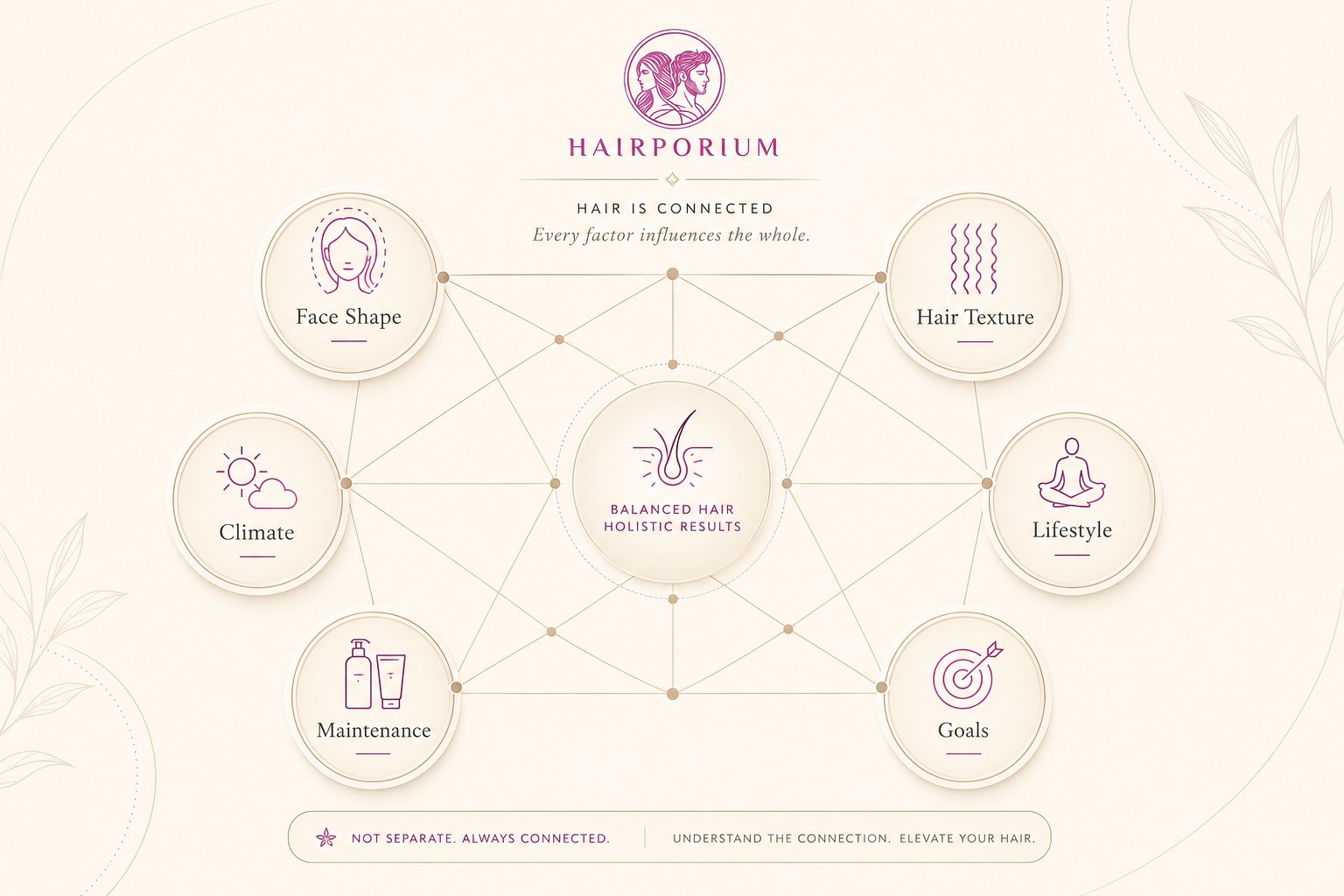
A hairstyle isn't only about looks. Appearance is just one piece of the puzzle; several factors need to work together for a good result, which is why picking something at random so often goes wrong.
Every hair choice involves several connected factors. Your face is the starting point, your hair's texture determines how a style falls, and your lifestyle affects how much time you have to manage it. These factors don't sit in separate boxes; they all influence each other.
Ignore any one of them and the whole decision can fall apart. A style might flatter your face but be impossible if your hair isn't thick enough to hold it. A color might look gorgeous but need more upkeep than you have time for. The choice isn't necessarily bad; it just wasn't fully thought through. Without considering everything together, you're missing information, and the result will be off.
Having too many options doesn't make deciding easier; it makes it harder. Faced with endless styles, products and techniques, it's easy to feel overwhelmed, spend ages comparing and lose sight of what you actually want.
That usually leads to putting the decision off or rushing into one just to get it over with, and both greatly increase the chance of getting it wrong.
A careful, step-by-step approach avoids that stress. It removes unsuitable options before you even see them, leaving a smaller, more relevant selection that's easier to assess. It simplifies the choice without lowering the standard. You're not losing options; you're removing distractions.
For most people, hair decisions are a bit of a gamble. You try something, see what happens and then try to fix it. You'll get there eventually, but it's hardly the fastest or cheapest route.
A systematic decision process makes the outcome far more predictable. With your details properly assessed and filtered, you're much more likely to get the result you want and to know what to expect before you start. The payoff is results that live up to your hopes, fewer mistakes to fix and much more confidence in your decision. You're not relying on luck; your choices are guided by a system that understands your hair.

The Hair Decision Engine doesn't just pick a hairstyle. It applies the same logic to every area of your hair, helping you make choices that go beyond appearance.
With styles, wanting something isn't enough; what matters is whether it will suit you. The system looks at how your face shape and hair texture work together to identify styles that will hold their shape and look balanced.
Rather than showing you what's trending, it focuses on styles that are a good match. The suggestions aren't just pretty in a photo; they work with your hair's natural character and behavior. You end up with a shortlist of styles that are realistic, manageable and right for you, not just nice to look at.
We often choose hair products based on advertising, recommendations or what's fashionable. But a product that's perfect for one person can be a disaster for another, depending on whether their hair is thick, fine or damaged.
The decision engine shifts the focus to what your hair actually needs, whether that's hydration, frizz control, repair or hold, and suggests products accordingly. That removes the guesswork. Instead of trying random products, you choose ones that suit your hair's structure and behavior.
Extensions, wigs and other add-ons bring another layer of complexity. They need to suit the look you want, but also your own hair and your lifestyle. If they're a poor match, they can be uncomfortable, look obviously fake or create a lot of work.
The system considers how well they'll blend with your hair, how they fit your lifestyle (your time, the upkeep involved and your climate) and whether they'll be practical in the long run. The aim is for add-ons to fit in easily rather than create new headaches.
A style is only as good as your ability to keep it looking good. Plenty of styles fail not because they're wrong for you, but because they take too much effort to maintain. The decision engine considers how much time you have each day, your styling skills and how much effort you're prepared to put in, then recommends styles you can actually keep up.
That balance of effort and outcome means your choice keeps looking good beyond the first day. At every step, Hairporium turns complicated details into clear decisions, so you choose something that not only looks good but works in the long run.
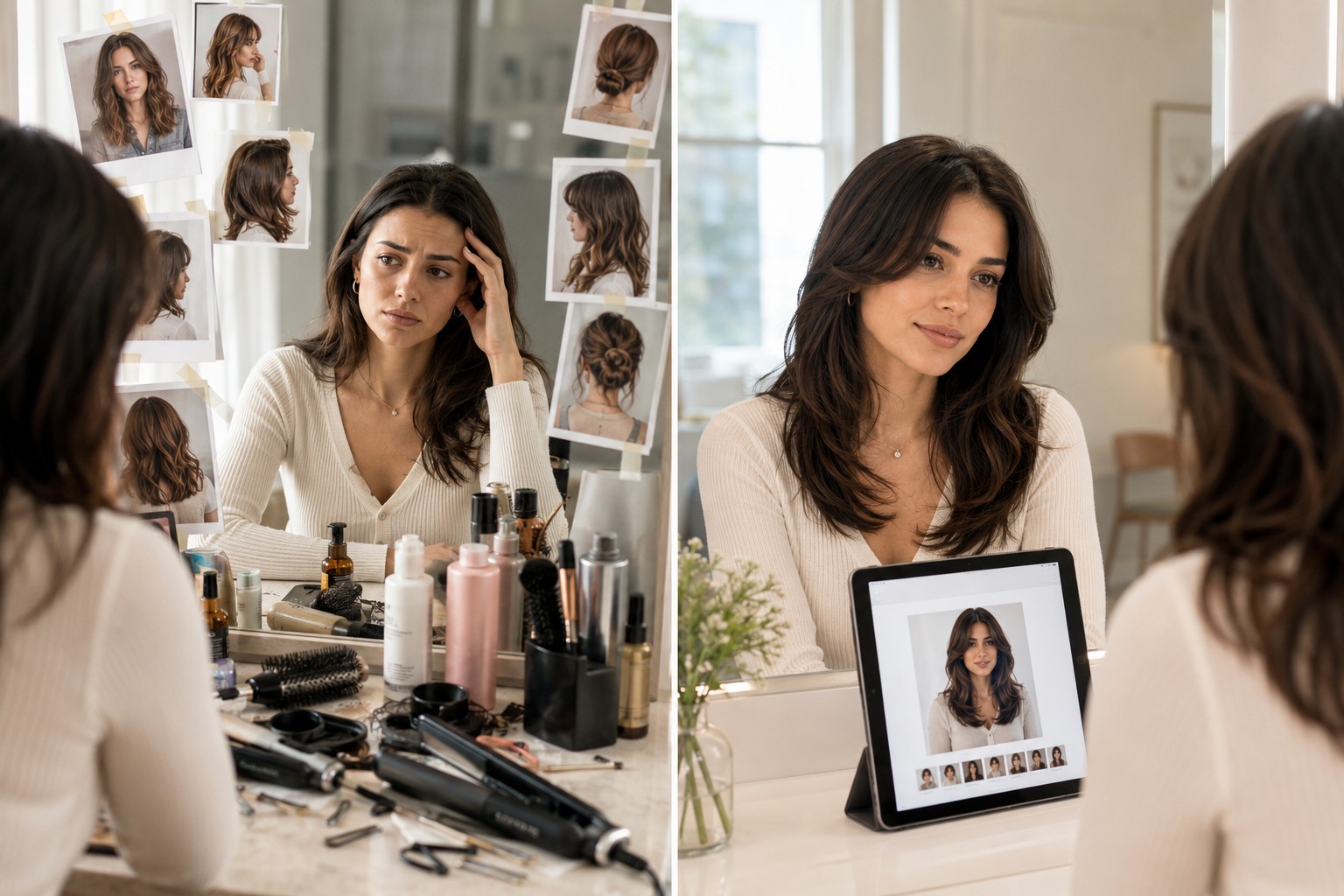
So how does this change the way you decide? Comparing hair decisions made with and without a structured approach shows that the difference isn't minor; it changes the whole process.
Without a structured system, most hair choices are reactive. You see something you like, try to copy it and hope for the best. The decision is driven by inspiration rather than careful assessment. You end up guessing what might suit you, copying trends without adapting them to your hair and piecing together advice from lots of different sources.
Because there's no consistent approach, every decision starts from scratch. One is based on something you saw on social media, another on a friend's suggestion and another on trial and error. Nothing links them, so the results are unpredictable.
Sometimes things go well, but often they don't, and you don't know why. You're fixing problems after the fact instead of making the right choice in the first place. Over time, that leads to frustration: you either become overly cautious or keep going round in circles.
With a structured system like the Hairporium Hair Decision Engine, the process is under your control and the outcome is more predictable. Instead of starting with inspiration, you start with your own details. Every decision follows a set path: your characteristics are assessed, the options are filtered and only those that fit move forward. That leaves you with a sensible shortlist.
You're not comparing everything; you're evaluating only what already meets your needs. Results are more consistent because they're based on how the factors connect, not on guesses. You know why a style or product should work before you try it. Most importantly, you feel more confident. Your decisions feel deliberate rather than experimental, and you're no longer at the mercy of chance or whatever's in fashion.
This is where you really see the benefit. It isn't just about making better choices in theory; it changes how you spend your money, how you explain what you want and what you can expect.
Buying hair products is often a shot in the dark. You try something that's been recommended and hope for the best, and too often it ends up unused on the shelf. A structured system removes that randomness by narrowing down the type of product to try based on what your hair needs (its texture, its condition and your goals) before you spend anything.
The result? You buy less of what you don't need, waste less money on products that don't work and finally find ones that do what you want. You choose with a clear understanding of what your hair needs instead of hoping something sticks.
At the salon, one of the biggest problems is being misunderstood. Showing your stylist a picture doesn't guarantee a style that suits you. With a structured way of working things out, you arrive knowing what will suit your face shape and hair type, how much upkeep you're willing to take on and what's realistically achievable. That makes the conversation with your stylist far more focused: instead of being vague, you give them information that helps them do a better job.
When you think things through before acting, you make fewer mistakes. You avoid choices that don't suit your hair or your life, so you need fewer fixes later. You're happier with the outcome, and any adjustments are small rather than a constant cycle of corrections. Over time, you start to trust your own judgment and make decisions with a clear head.
Hair decisions are changing. Instead of chasing the latest trends, the emphasis is shifting to a more considered approach, one that uses a clear process to help you get the look you want.
For years, the hair world has revolved around inspiration. People searched for pictures, collected ideas and tried to copy what they saw. That produced plenty of looks but no guarantee you'd like the result. Now things are moving toward systems. Instead of starting with a picture, you start with your own hair and what it needs, then use a process to narrow down your choices.
Inspiration is still useful, but it's no longer the first step; it's something you weigh up within the process. That reduces confusion. Instead of asking "What's fashionable?", you ask "What will actually work for me?", and that simple change makes a big difference to the quality of your choices. Systems are also consistent: once you have a way of deciding, every choice follows the same steps, so you're more likely to get good results every time.
AI is becoming a bigger part of personal care, but its role is changing. It's no longer just about generating ideas; it's about helping you decide. Decision engines combine AI with an organized framework: they look at the facts, apply the right filters and give you results that are relevant and realistic.
In hair care, this solves a common problem: too many factors to think about and not enough clarity. By turning those factors into a system, it makes choosing far more manageable. Hairporium is at the forefront of this shift, moving hair decisions away from what looks good in a picture and toward smart, informed choices.

Ultimately, hair decisions don't have to be a gamble. Most of the frustration people feel comes from guessing instead of following a method. Once you switch to a system, everything changes: choosing becomes easier, you're more confident in the results and you have more control over the whole process.
Instead of reacting to what's popular or trying whatever comes to mind, you make choices that suit you. An AI Hair Stylist working with a Hair Decision Engine brings that structure to your routine, replacing muddled thinking with a clear process that helps you weigh up your options before you act.
And it's not just about better hair; it's about how you approach every decision. You move from uncertainty to confidence, and from trying and hoping to making informed choices. The next step isn't finding a better picture for inspiration. It's adopting a better system, one that lets you decide with confidence rather than just hoping for the best.
A structured guidance system that helps people make better hair decisions by combining your face shape, hair type, lifestyle and goals — turning a complex choice into a step-by-step process instead of relying on trends or trial-and-error.
Most AI hair tools focus on virtual try-ons — showing you what a style might look like without considering whether it actually suits you. Hairporium's AI Stylist runs your details through structured decision filters covering face shape, hair type, and lifestyle to recommend styles that genuinely work for you.
Through four layers: Input (gathers details about your face, hair, and lifestyle), Decision Filters (narrows down what actually works), Compatibility Mapping (explains why each choice works), and Output (actionable, personalized recommendations).
No. A human stylist brings experience, intuition, and the ability to physically work with your hair. The AI Stylist brings consistency, structured analysis, and accessibility — it helps you arrive at the salon already knowing what works, making the conversation with your stylist sharper and more productive.
By filtering options before you buy or commit, you stop guessing. You buy fewer products you don't need, you walk into the salon knowing what suits you, and you reduce the regret-and-redo cycle that costs both time and money.
Continue exploring the other Hairporium guides covering hairstyle decisions, wigs, extensions, maintenance, lifestyle, and hair problems.
What Hairstyle Suits Me?How to Choose the Right WigHow to Choose Hair ExtensionsHair Maintenance GuideHairstyles by LifestyleHair Problems GuideThe Hairporium AI Hair Stylist runs your face shape, hair type, and lifestyle through the Hair Decision Engine to recommend styles, products, and routines that actually work for you. Free, no account needed.
Try the Hair Decision Engine →